BISP 8171 New Payment Update 2027: Amount Increased to Rs 19,500 and Beneficiaries Expand to 10.2 Million
BISP 8171 New Payment Update 2027
The Government of Pakistan has announced a significant increase in the Benazir Income Support Programme payment amount, bringing much-needed financial relief to millions of low-income families across the country. According to official sources, the quarterly payment will be raised from the current 14,500 rupees to 19,500 rupees starting from January 2027, representing an increase of 5,000 rupees per payment cycle. This decision reflects the government’s ongoing commitment to protecting the most vulnerable segments of society from rising inflation and economic pressure.
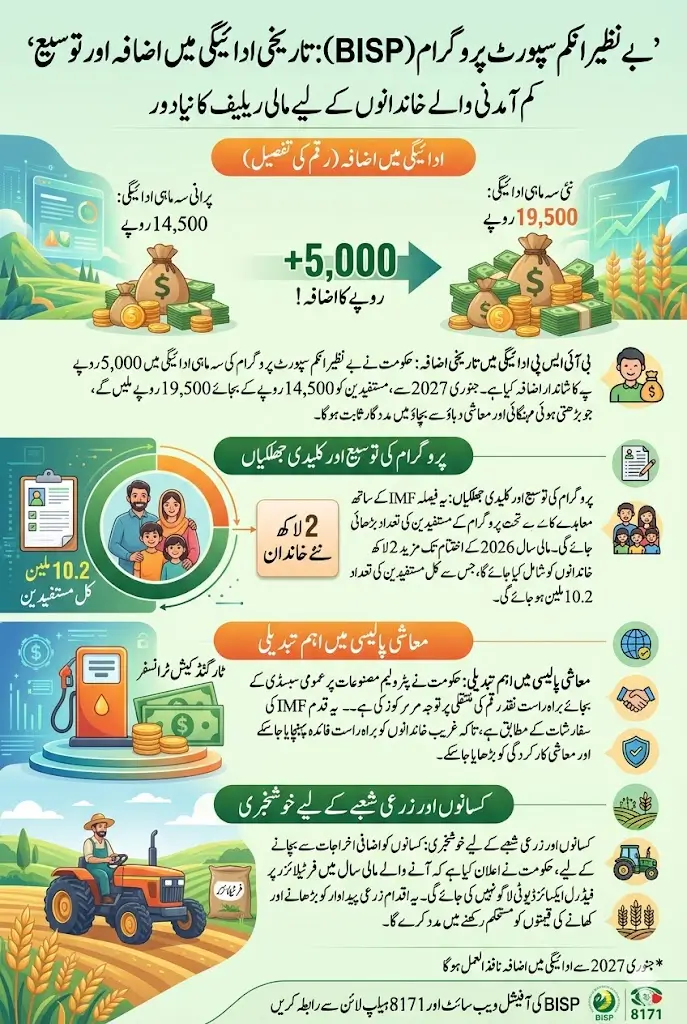
This update comes as part of a broader agreement between the federal government and the International Monetary Fund, under which Pakistan has provided written assurances that the number of BISP beneficiary households will continue to grow over time. The expansion plan includes adding 200,000 more families to the program before the end of financial year 2026, pushing the total number of registered beneficiary households to 10.2 million across Pakistan.
You Can Also Read: Will Petrol Prices Drop Today and Will People Get Subsidy After Strait of Hormuz Reopens? Official Update Released
Why the Government Decided to Increase the BISP Payment Amount?
The decision to raise the BISP payment was not made in isolation but is directly connected to a series of economic discussions and policy commitments at both the national and international level. The IMF had previously raised concerns about blanket subsidies on petroleum products, urging the government to move toward a more targeted approach to social protection. In response, the federal government accepted this recommendation and shifted its strategy toward direct cash transfers instead of general fuel subsidies.
As part of this policy shift, the Ministry of Finance directed provincial governments to allocate funds from their own budgets to provide targeted subsidies for lower-income groups within their jurisdictions. The federal government made a clear decision that petroleum prices in Pakistan would align with international market rates going forward, while social protection would be strengthened through direct financial assistance programs like BISP rather than through generalized fuel price reductions.
Key Highlights of the BISP Payment Update
This update carries several important changes that directly affect current and future beneficiaries of the program. Understanding these changes helps families plan ahead and know what to expect from the system in the coming months.
- The quarterly payment amount will increase from 14,500 rupees to 19,500 rupees
- The new payment amount will be effective from January 2027 onwards
- An additional 200,000 families will be registered before the end of financial year 2026
- Total beneficiary households will reach 10.2 million after the new enrollments
- The government has submitted written confirmation to the IMF about expanding the program
- Provincial governments have been directed to provide targeted subsidies from their own budgets
- Petroleum prices will be set in line with global market rates going forward
- Fertilizer will not be subject to Federal Excise Duty in the next financial year to protect farmers
These points summarize the full scope of the BISP update and show that the changes go beyond just a payment increase, touching upon broader economic policy directions for the country.
You Can Also Read: WhatsApp Adds Multiple Accounts Support And New Features for iOS Full Details 2026
Impact of the 5000 Rupee Increase on Low-Income Families
A monthly increase of this size carries real and practical significance for families who depend on BISP as their primary source of financial support. For households where daily expenses are calculated carefully and every rupee matters, an additional 5,000 rupees per quarter provides meaningful breathing room to cover food, medicine, school fees, and utility bills. The increase acknowledges that the cost of living has risen sharply in recent years and that the previous payment amount was no longer sufficient to meet the basic needs of poor families.
The government’s decision to maintain and expand this program even while complying with IMF conditions demonstrates that social protection remains a priority in the national budget. Rather than reducing welfare spending to meet fiscal targets, Pakistan has chosen to restructure its subsidy model so that direct support reaches those who need it most, rather than being distributed broadly through price controls that often benefit middle and upper-income groups as well.
BISP Beneficiary Expansion Plan and New Enrollment
Along with the payment increase, the expansion of the beneficiary base is equally significant for communities that have previously been left out of the program. Adding 200,000 new households before June 2026 means that registration activities are already underway in many districts, with priority being given to areas where poverty levels are highest and social protection coverage has historically been low.
Families who have not yet registered for BISP or who were previously found ineligible are encouraged to visit their nearest BISP tehsil office or use the 8171 helpline to check their eligibility status. The National Socio-Economic Registry is regularly updated, and new surveys are conducted to identify deserving households that may have been missed in earlier assessments. Citizens can also send their CNIC number via SMS to 8171 to receive an immediate update on their registration and payment status.
Payment Comparison Before and After the Update
The table below provides a clear side-by-side view of how the BISP payment structure is changing and what beneficiaries can expect from January 2027 onwards.
| Detail | Current Amount | Updated Amount (Jan 2027) |
|---|---|---|
| Quarterly Payment | Rs 14,500 | Rs 19,500 |
| Increase Per Quarter | — | Rs 5,000 |
| Total Beneficiary Households | 10 million | 10.2 million |
| New Families to Be Added | — | 200,000 |
| Effective Date | Ongoing | January 2027 |
The table above makes it clear that both the financial value and the coverage of the program are being expanded simultaneously, which strengthens the overall impact of the initiative on poverty reduction across Pakistan.
You Can Also Read: Eligible For BISP Wallet SIM Issuance And Payment Withdrawal Details Step By Step
Connection Between BISP Expansion and IMF Agreement
One of the more significant aspects of this announcement is that the government has formally communicated its BISP expansion commitments to the IMF in writing. This is not simply a domestic welfare announcement but part of a structured agreement between Pakistan and its international financial partners. The IMF had requested that Pakistan reduce blanket subsidies on petroleum products, which tend to benefit all income groups rather than targeting the poor specifically.
In place of fuel subsidies, the government has chosen to strengthen direct cash transfer programs like BISP, which ensures that financial support reaches only those who genuinely need it. This approach is considered more economically efficient and socially just because it avoids the distortion that general subsidies create in the energy market while still protecting vulnerable households from the financial impact of higher fuel prices.
Role of Provinces in Providing Targeted Subsidies
The federal government’s decision to align petroleum prices with global markets has placed additional responsibility on provincial governments to support their own low-income populations. The Ministry of Finance has formally advised all provinces to design and fund targeted subsidy schemes from their own budgets for deserving segments of society. This is why initiatives like the Punjab Sasta Petrol Program have gained importance as complementary provincial efforts running alongside the federal BISP program.
This coordination between federal and provincial governments creates a layered social protection system where citizens can benefit from both national cash transfers and locally designed subsidy programs. The result is a more comprehensive safety net that addresses different aspects of poverty including food, fuel, healthcare, and education at different levels of government.
You Can Also Read: Zewar-e-Taleem Program Closed in Punjab Complete Details Step By Step 2026
Fertilizer Duty Exemption for Farmers
Alongside the BISP payment increase, the government has also announced that Federal Excise Duty on fertilizer will not be applied in the upcoming financial year. This decision is specifically aimed at protecting the agricultural sector and ensuring that farmers, who are among the most economically vulnerable groups in Pakistan, do not face additional input costs during the next crop season.
The exemption on fertilizer duty directly lowers the cost of farming and helps maintain food production at affordable levels, which in turn benefits the entire population by keeping food prices relatively stable. This measure, combined with the BISP payment increase, forms part of a wider strategy to support both rural and urban poor households through multiple channels of government assistance.
Final Thoughts
The BISP 8171 payment update for 2027 represents one of the most important social welfare decisions made by the Pakistani government in recent years. Increasing the quarterly payment to 19,500 rupees while simultaneously expanding coverage to 10.2 million households shows a clear intention to strengthen the country’s social protection framework even under difficult fiscal conditions. Families currently enrolled in the program can look forward to receiving higher payments from January 2027, while new households being added to the system will gain access to much-needed financial support for the first time.
This update also signals a shift in how the government approaches poverty relief, moving away from general subsidies toward more precise, data-driven cash transfer programs. The combination of federal BISP payments, provincial subsidy initiatives, and agricultural duty exemptions creates a more complete and targeted support system for Pakistan’s most vulnerable citizens.
You Can Also Read: CM Punjab Climate Leadership Development Program Online Registration 2026 Full Guide
FAQs
When will the increased BISP payment of 19,500 rupees start?
The new payment amount will take effect from January 2027 and will replace the current quarterly payment of 14,500 rupees for all registered beneficiaries.
How many new families will be added to BISP before June 2026?
The government plans to enroll an additional 200,000 households by the end of financial year 2026, bringing total beneficiaries to 10.2 million.
Why did the government increase the BISP amount instead of giving fuel subsidies?
The IMF requested an end to blanket petroleum subsidies, so the government redirected that support into targeted cash transfers through BISP for low-income families.
How can a new family apply or check eligibility for BISP?
Citizens can send their CNIC number to 8171 via SMS or visit their nearest BISP tehsil office to check their registration and payment eligibility status.
Will farmers receive any separate benefit under this new policy update?
Yes, the government has decided to exempt fertilizer from Federal Excise Duty in the next financial year to reduce farming costs and protect the agricultural sector.