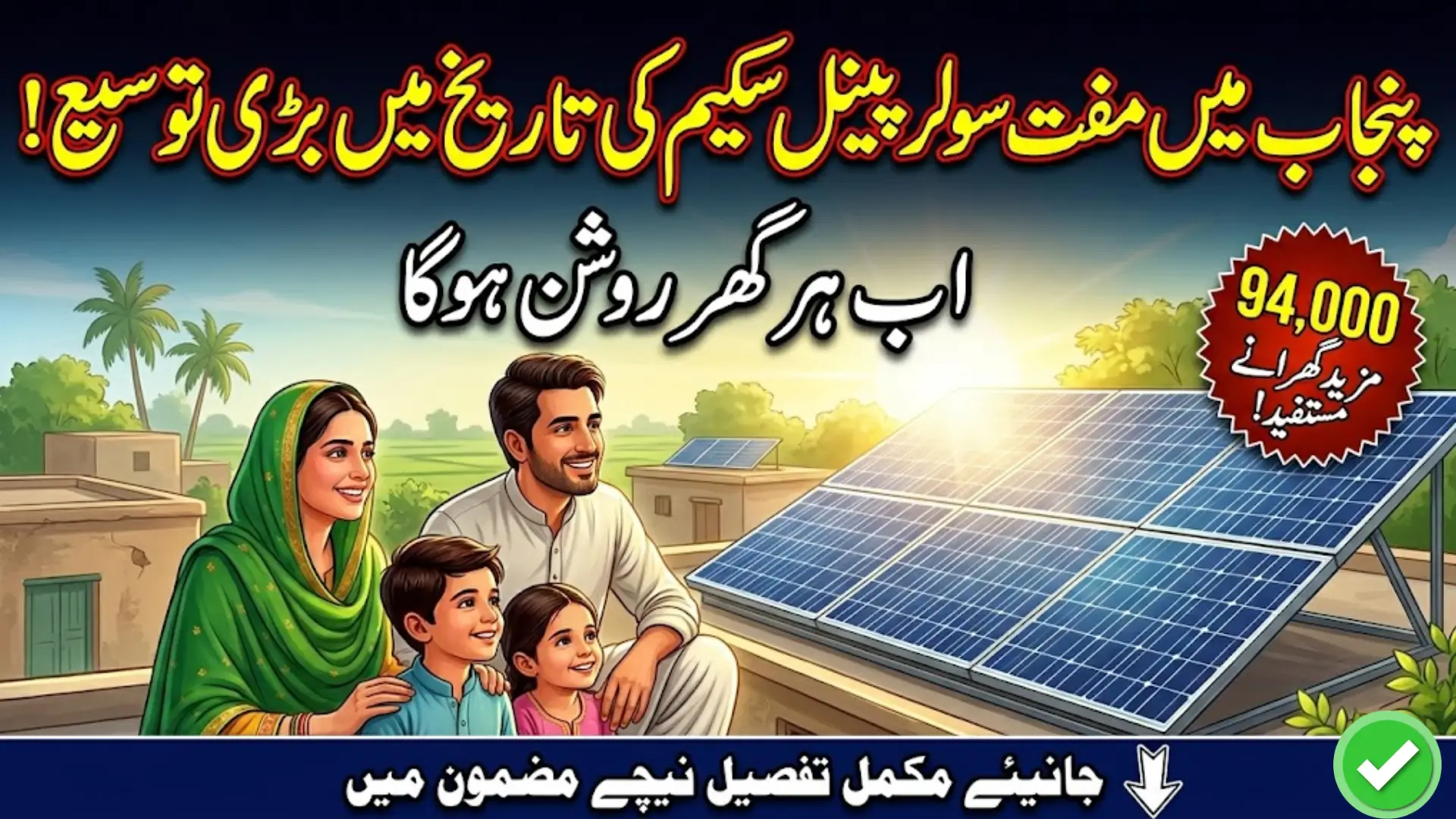
Punjab Extends Free Solar Panel Scheme 2026 Deadline! 94,000 More Systems To Be Distributed To Poor Families
Punjab Extends Free Solar Panel Scheme 2026 Deadline
The Punjab government has taken a major step forward in its mission to bring clean and affordable energy to the doorsteps of low-income families across the province. In a significant policy decision, the government has officially extended the deadline for its free solar panel scheme by six full months, pushing the cutoff from June 2026 all the way to December 2026. This extension is not just a calendar change, it comes with a fresh financial commitment and a revised distribution target that will benefit tens of thousands of additional deserving households.
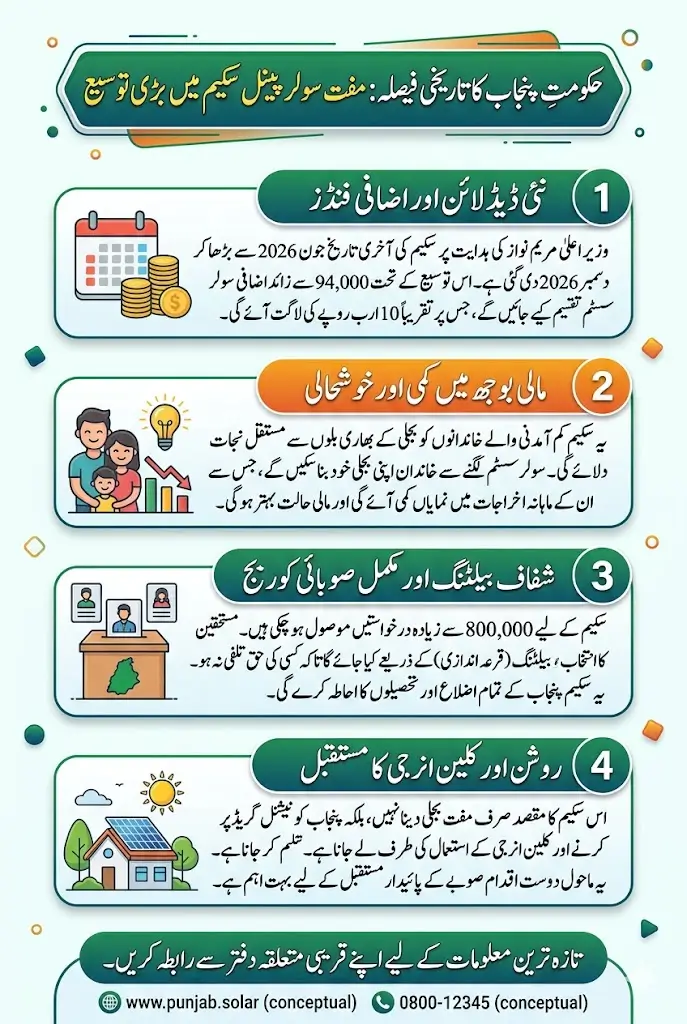
The decision was made on the direct instructions of Chief Minister Maryam Nawaz, who has consistently positioned solar energy access as a priority for her administration. With electricity bills continuing to burden low-income families across Punjab, the free solar panel scheme represents a practical and lasting solution. Rather than offering temporary relief, a solar system gives a family the ability to generate their own electricity for years to come, fundamentally changing their financial situation for the better.
You Can Also Read: Pak ID App Now Lets Parents Get Child B-Form Online Without Visiting NADRA Centre Full Process Explained
Why the Deadline Was Extended and What It Means?
When the free solar panel scheme was first launched, the response from Punjab’s residents was nothing short of extraordinary. Over 800,000 applications were received from families across the province, a number that far exceeded initial projections and made it clear that the original timeline and distribution target were not going to be sufficient to meet the actual demand on the ground. Extending the deadline was not a sign of failure but rather a direct response to how desperately needed this program is.
By pushing the deadline to December 2026 and allocating additional funding, the government has acknowledged that the original scope of the scheme needed to grow. This kind of responsive policymaking is exactly what large-scale welfare programs require. Families who missed the initial application window or were placed further down the waiting list now have renewed hope that they will be reached before the program concludes.
Scope of the Extended Scheme at a Glance
Understanding the full scale of this extended program helps put the government’s commitment into perspective. The numbers involved are substantial, and they reflect a genuine effort to make a measurable difference in the lives of Punjab’s most financially vulnerable residents. This is not a token gesture but a province-wide initiative backed by real funding and a structured distribution mechanism.
- The scheme deadline has been officially extended from June 2026 to December 2026
- More than 94,000 additional solar systems will be distributed under the revised plan
- The total estimated cost of the expanded distribution is nearly Rs. 10 billion
- Solar systems will be provided completely free of charge to selected low-income households
- The balloting process will be used to select beneficiaries fairly and transparently
- Distribution will cover all districts and tehsils across the entire province of Punjab
- Over 800,000 applications have already been received from interested families
These figures paint a clear picture of both the scale of need and the scale of the government’s response. Reaching every district and tehsil ensures geographical fairness, while the balloting system adds a layer of transparency to the selection process.
How the Balloting Process Works for Solar Panel Distribution?
One of the most important aspects of this scheme is how beneficiaries are selected. With hundreds of thousands of applications already received, the government cannot simply hand out solar systems on a first-come, first-served basis. To ensure that the process is fair and that truly deserving families are prioritized, a balloting system has been put in place for the distribution of solar panels across Punjab.
The balloting process is designed to remove favoritism and ensure that low-income families from all parts of the province have an equal chance of being selected. This approach adds credibility to the scheme and builds public trust in the distribution mechanism. Families who have already applied should remain patient and keep their contact information updated so they can be reached when their area’s balloting takes place.
You Can Also Read: BISP 8171 Fraud Alert: How to Stay Safe From Fake Messages and Scammers Step-By-Step Guide
Key Facts About the Free Solar Panel Scheme
The following table brings together the most important information about the extended scheme in one place, making it easy for applicants and interested families to understand where things stand right now.
| Detail | Information |
|---|---|
| Scheme Name | Punjab Free Solar Panel Scheme |
| Announced By | Chief Minister Maryam Nawaz |
| Previous Deadline | June 2026 |
| Extended Deadline | December 2026 |
| Additional Systems | More than 94,000 solar systems |
| Total Estimated Cost | Nearly Rs. 10 billion |
| Cost to Beneficiary | Completely free of charge |
| Selection Method | Balloting process |
| Coverage Area | All districts and tehsils of Punjab |
| Applications Received | Over 800,000 |
This table captures everything a resident of Punjab needs to know at a glance. The scheme is large, well-funded, and designed to reach families who genuinely cannot afford solar energy on their own.
Who Benefits and Why This Scheme Matters So Much?
The free solar panel scheme is specifically targeted at low-income consumers, meaning families who struggle the most with rising electricity costs in Punjab. For these households, monthly electricity bills represent a significant and often unmanageable portion of their income. A single high bill can derail an entire month’s budget, forcing families to choose between paying for electricity and meeting other basic needs like food, medicine, or children’s education.
A solar system changes this equation entirely. Once installed, it generates electricity from sunlight at no recurring cost, which means the family’s monthly bills drop dramatically or disappear almost entirely depending on their usage. Over the years, the savings accumulate into a figure that far exceeds the original cost of the system, making this one of the most financially impactful welfare interventions the Punjab government has undertaken in recent memory.
You Can Also Read: Punjab Veterinary Internship Program 2026-27: 1000 Seats, PKR 60,000 Monthly Stipend
Why Punjab’s Solar Plan Is Bigger Than Just Free Electricity?
The extension of the free solar panel scheme fits into a broader vision that the Punjab government has been building around renewable energy and sustainable development. Providing solar systems to low-income families is not just about reducing electricity bills, it is also about reducing dependence on the national grid, lowering carbon emissions, and moving the province toward a cleaner energy future.
Punjab is Pakistan’s most populous province, and the energy choices made here have national implications. By introducing hundreds of thousands of households to solar power through a free scheme, the government is also building awareness and familiarity with renewable technology among communities that might otherwise never have had access to it. This cultural shift toward clean energy thinking could have lasting effects well beyond the scheme’s official end date in December 2026.
The benefits of this approach extend in multiple directions:
- Low-income families gain long-term financial relief from reduced electricity costs
- Punjab’s overall demand on the national grid decreases, easing pressure on the power system
- Carbon emissions are reduced as solar energy replaces fossil-fuel-based electricity
- Communities in remote districts gain access to reliable electricity that grid supply could not always guarantee
- The scheme creates awareness about solar technology among populations who were previously unfamiliar with it
Each of these outcomes contributes to a stronger, more resilient Punjab in ways that go beyond the immediate benefit of a free solar panel.
Final Words
The Punjab government’s decision to extend the free solar panel scheme to December 2026 and commit nearly Rs. 10 billion to distribute 94,000 more systems is a powerful statement of intent. It shows that when a welfare program proves its worth and demand exceeds expectations, the right response is to expand rather than retreat.
For the hundreds of thousands of families waiting to benefit from this scheme, the extension brings renewed hope and a longer window of opportunity. If you have already applied, stay connected and keep your information updated. If you have not yet applied, now is the time to find out how you can be part of a program that could genuinely change your household’s financial future for years to come.
You Can Also Read: BISP 8171 Installment 2026 Released In Lodhran! Know How and Where to Get Installment Rs. 14,500
FAQs
What is the new deadline for the Punjab free solar panel scheme?
The deadline has been officially extended to December 2026, giving more families across Punjab the chance to benefit from the program.
How many solar systems will be distributed under the extended scheme?
More than 94,000 additional solar systems will be provided to low-income families across all districts and tehsils of Punjab.
Do beneficiaries have to pay anything to receive a solar panel?
No, the solar systems are being distributed completely free of charge to selected low-income households with no cost to the beneficiary.
How will families be selected to receive solar panels under this scheme?
Beneficiaries will be selected through a transparent balloting process to ensure fair distribution across all areas of Punjab.
How many applications have already been received for the solar panel scheme?
Over 800,000 applications have already been submitted by families across Punjab who are hoping to benefit from this initiative.